

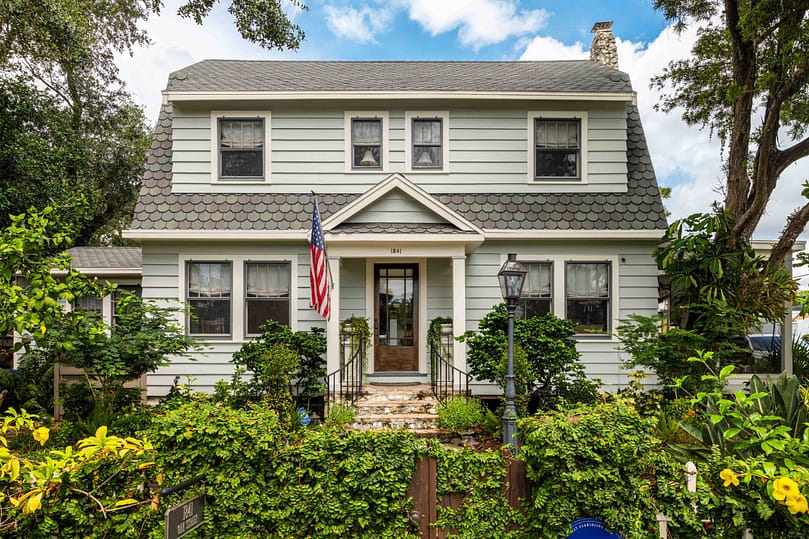
Colonial Homes For Sale in Sarasota
Ben Nathan provides luxury real estate representation to buyers and sellers of Colonial and Colonial Revival homes in Sarasota.
True Colonial architecture is uncommon here but the style still appears in pockets of the market, and it remains one of the most searched-for architectural terms among buyers relocating from the Northeast and Mid-Atlantic.
Colonial Homes listed for sale in Sarasota
Explore Colonial and Colonial Revival homes for sale in Sarasota. This section may be empty at times. This is because Colonial Homes are rare in Sarasota.
A Brief History of Colonial Homes
Colonial architecture in America dates to the 17th and 18th centuries, when British, Dutch, French, and Spanish settlers adapted the building traditions of their home countries to new materials, climates, and ways of life. In New England and the Mid-Atlantic, this produced the style most Americans picture when they hear "Colonial": a symmetrical, timber-framed or brick house with a central door, evenly spaced windows, and a simple gabled roof, refined over time with the classical proportions of Georgian design imported from England.
After the Revolution, Colonial forms evolved into the more delicate Federal style, and by the early 20th century, a nationwide Colonial Revival movement reintroduced and reinterpreted these historic forms for modern living — larger windows, updated floor plans, and a more decorative use of the classical detailing early Colonial builders had used sparingly. It's this Colonial Revival strand, not the original 1700s form, that shows up in most homes described as "Colonial" in today's real estate listings, including any that appear in Sarasota.
Features of Colonial Homes
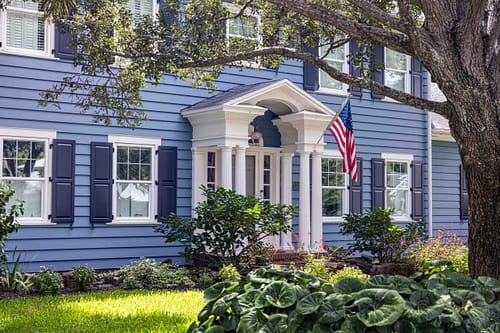
- Strict symmetry — evenly spaced windows and centered front door
- A formally decorated front entry
- Multi-pane double-hung windows, frequently with shutters
- Side-gabled or hipped roofline, moderate pitch, minimal overhang
- Brick or clapboard siding
- A central chimney
- Restrained ornamentation
Types of Colonial Homes
Georgian Colonial
This is the most formal of the Colonial styles. It is defined by exacting symmetry, brick construction, and a decorative crown or pediment over the front door. In addition, a matching pair of chimneys often flanks the house.
New England Colonial
These homes are timber-framed, with clapboard siding, steep gabled roofs, and a central chimney. Because winters were cold, the chimney was designed to heat multiple rooms. Likewise, builders relied on locally available lumber.
Dutch Colonial
You can recognize this style by its gambrel, or barn-style, roof with flared eaves. Also, dormer windows are often tucked into the upper story. Historically, it was common in the former Dutch settlement areas of New York and New Jersey.
French Colonial
This style developed for hot, humid climates along the Gulf Coast and Caribbean. For example, it features raised main floors, steep hipped roofs, and deep wraparound porches called galleries. These porches provide both shade and airflow. Of all the Colonial variants, this one has the most in common with Florida’s vernacular building tradition.
Southern Colonial
Southern Colonial homes feature grand, two-story porticos with tall columns spanning the full facade. In fact, the style is a later, more theatrical evolution of Georgian symmetry. It first became popular in the 19th century.
Colonial Revival
This 20th-century reinterpretation borrows the symmetry and detailing of historic Colonial styles. However, it pairs them with modern floor plans, larger windows, and updated proportions. This is the form most likely to appear in Sarasota. Usually, it is a custom-built home rather than part of a historic streetscape.
Famous Colonial Homes in Sarasota
This 20th-century reinterpretation borrows the symmetry and detailing of historic Colonial styles. However, it pairs them with modern floor plans, larger windows, and updated proportions. This is the form most likely to appear in Sarasota. Usually, it is a custom-built home rather than part of a historic streetscape.
3308 Higel House, Siesta Key
Siesta Key pioneer Harry Higel built this Colonial Revival home in 1917 on historic Bayou Louise. Inside, it features pecky cypress walls and heart-pine floors. In addition, its light-filled two-story design opens onto the water. Since the 1980s, owners have lovingly restored it. As a result, it remains one of Siesta Key’s most storied and architecturally significant residences.
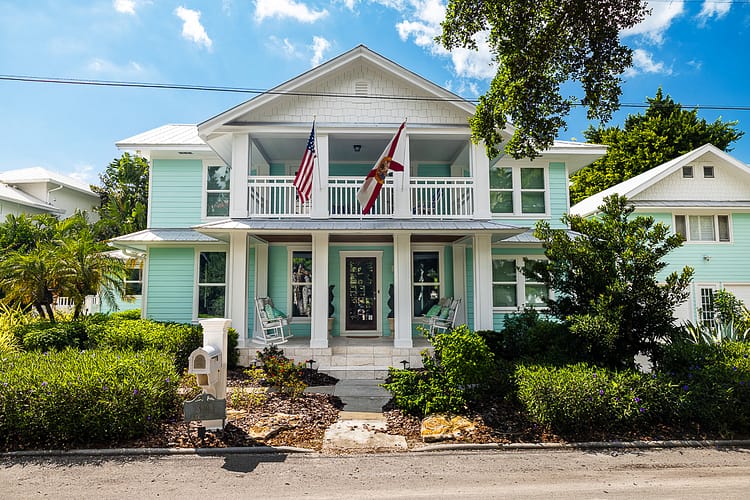
Built in 1917 by Siesta Key pioneer Harry Higel.
Lord-Higel House, Venice, Florida
Entrepreneur Joseph Lord built the Lord-Higel House in 1896. Today, it is the second oldest house in Sarasota County. Eventually, Mr. Higel’s son moved the house to family property west of its original site. Then, in 2005, it was moved again to its present location on Granada Avenue. At that time, the City of Venice acquired it.
4521 Bayshore Rd, Sarasota, Florida - The Earle House
Few homes capture Sarasota’s early resort era like the Earle House. Built in 1927 for George Earle, it blends Classical Revival design with Georgian influences. Remarkably, the house remains virtually unaltered. In fact, it is still in excellent condition nearly a century later.
Earle bought his bayfront parcel in Indian Beach in 1925. The neighborhood was first platted in 1891. Afterward, it was promoted as an “ultra-exclusive” winter enclave. As a result, it drew wealthy northerners, including the Ringling Brothers, to the calm waters of Sarasota Bay.
First, Earle built a modest cottage on the north end of his land. Then, he commissioned this grander home just to the south. Original plans credit Clas & Shepard, a firm with offices in Sarasota and Milwaukee. Its leader, Alfred C. Clas, designed much of Milwaukee’s park architecture. Moreover, the firm earned gold medals at the Chicago, St. Louis, and Paris expositions. Fittingly, the house was listed on the National Register of Historic Places in 1993.
Frequently Asked Questions about Colonial Homes
Sarasota’s architectural identity grew from the Mediterranean Revival estates of the Ringling era. Later, the internationally recognized Sarasota School of Architecture shaped the city’s look. Consequently, traditional Colonial architecture never took hold locally. When a Colonial or Colonial Revival home does come to market, it’s usually a custom build. Typically, these homes sit in inland or golf communities rather than established Colonial neighborhoods. That’s why each one is something of a find for buyers seeking the style.
Ben works with many relocating buyers, especially those from the Northeast and Mid-Atlantic. These buyers often know exactly what they want architecturally. Therefore, Ben helps them understand where and how often true Colonial inventory appears in this market.
Are there Colonial-style homes for sale in Sarasota?
They're uncommon. Sarasota's architectural character leans heavily toward Mediterranean Revival and Modern, so Colonial and Colonial Revival homes appear very occasionally, usually as custom builds rather than part of a historic Colonial neighborhood.
What's the difference between Colonial and Colonial Revival?
Colonial refers to the original 17th- and 18th-century American style. Colonial Revival is the 20th-century reinterpretation of that style for modern living — most homes marketed as "Colonial" today, including any in Sarasota, are technically Colonial Revival.
What's the difference between Georgian and Colonial style?
Georgian is one specific, highly formal strand of Colonial architecture, defined by strict symmetry, brick construction, and classical detailing borrowed directly from English design. "Colonial" is the broader umbrella term covering Georgian along with Dutch, French, New England, and Southern variants.
Planning to buy or sell a Colonial home?
Let’s get in touch